Owner’s manual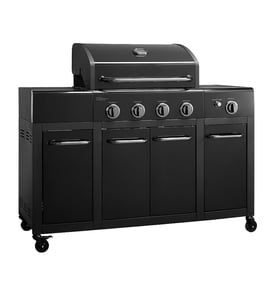
What is the average lifespan of a gas grill?
A Kenmore gas grill like model 12233492412 typically lasts 5 to 15 years. With regular cleaning, correct fuel setup, and replacing wear items (burners, igniter parts, regulator/hose), many grills reach the upper end of that range.
Typical lifespan ranges
| Grill type | Typical lifespan | What usually ends it |
|---|---|---|
| Budget painted-steel grill | 2 to 5 years | Firebox rust, burner failure |
| Mid-range grill | 5 to 10 years | Burners, heat plates, ignition issues |
| Heavier stainless or well-maintained grill | 10 to 15 years (sometimes longer) | Frame/firebox corrosion, repeated burner replacements |
What makes a gas grill last longer
We see grill life extend the most when you stay ahead of grease, corrosion, and gas-flow problems.
- Keep the grill outdoors only and maintain proper clearance and ventilation (helps prevent overheating and damage).
- Clean grease and drippings regularly to reduce flare-ups and corrosion.
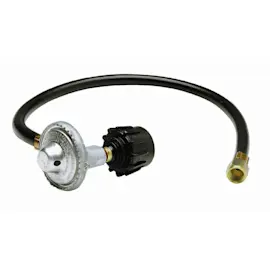
- Inspect the pressure regulator and hose before each use; replace if cracked, cut, or heavily worn.
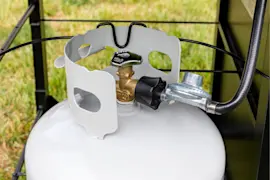
- Turn off gas at the LP tank when the grill is not in use.
- Use the correct LP tank size (standard 20 lb) and keep the cylinder upright.
For model-specific safety, placement, and fuel guidance, follow the 12233492412 owner's manual.
Quick “replace vs. repair” checklist
A few common symptoms help decide whether a repair is worth it.
- Worth repairing: uneven heat, one burner not lighting, weak ignition spark, worn wheels.
- Often replace the grill: severe firebox/frame rust-through, repeated gas leaks, multiple major components failing at once.
- Always stop and address immediately: strong gas smell or hissing; shut off gas and follow the manual’s safety steps.
Why it matters
A grill’s lifespan is mostly about safe, consistent gas flow and controlling grease and moisture. Simple habits like hose inspections, proper LP tank use, and routine cleaning prevent the failures that end grills early.
Optional help for maintenance and performance: how to clean a gas grill video.
Last updated: January 2026
How to move a large grill?
To move a large Kenmore gas grill model 12233492412, we recommend shutting off and disconnecting the LP tank, removing loose/heavy components, and rolling the grill on its wheels with a helper. For lifting into a vehicle, use a dolly and secure it with ratchet straps.
Safety first (LP gas and burn risk)
Before you move the grill, treat it like a fuel appliance, not just patio furniture.
- Turn all burner control knobs to OFF.
- Make sure the grill is completely cool.
- Turn the LP cylinder valve OFF (clockwise until it stops).
- Disconnect the regulator from the tank (coupling nut counterclockwise).
- Install the tank dust cap when the cylinder is not in use.
- Keep the LP tank upright and secured during transport.
For the exact LP cylinder disconnect steps for this model, use the 12233492412 owner's manual.
Best ways to move it (short move vs. transport)
| Move type | Best method | What to avoid |
|---|---|---|
| Across patio/driveway | Roll it with 2 people guiding | Pulling by side shelves or control panel |
| Over thresholds/steps | Appliance dolly with straps | Dragging (can bend the cart and firebox) |
| Into a truck/trailer | Ramp plus dolly; then strap down | Lifting by lid handle or doors |
Prep steps that make moving easier
These steps reduce weight and prevent damage.
- Remove cooking grates, heat diffusers, and grease tray; carry them separately.
- Empty the grease tray to reduce spills and flare-up residue.
- Close and latch doors; tape them shut if needed.
- Fold side shelves (if equipped) and remove any accessories.
- Protect the control knobs and igniter area from bumps.
Why it matters
Moving a grill with the LP tank connected or with grease sloshing in the tray increases the risk of leaks, spills, and damage to the regulator, valves, and burner tubes. A careful disconnect and a stable dolly move protects the fuel system and keeps the grill heating evenly afterward.
Last updated: January 2026
How big is a 4 burner gas grill?
A 4-burner gas grill is typically a full-size backyard grill; most measure about 45 to 60 inches wide, 20 to 25 inches deep, and 45 to 50 inches tall with the lid closed. For your Kenmore 12233492412, confirm the exact assembled dimensions in the 12233492412 owner's manual.
Typical size and capacity ranges
Most 4-burner grills fall into these common ranges:
- Primary cooking area: about 400 to 550 sq. in.
- Total cooking area (with warming rack): about 500 to 700 sq. in.
- Main burner output: often 30,000 to 50,000 BTU total
- Weight: commonly 70 to 130 lb.
- Fuel: LP (20 lb tank) is most common; some models can be converted to natural gas with the correct kit
Space planning: grill footprint vs. safe clearance
The grill’s physical size is only part of “how big” it needs to be. Your Kenmore 12233492412 manual calls for outdoor-only use and at least 36 inches of clearance from the back and sides to combustible surfaces.
| What you’re measuring | What it includes | Why it changes |
|---|---|---|
| Grill width | Firebox plus side shelves | Shelves may fold or be fixed |
| Grill depth | Firebox plus handle | Lid/handle design varies |
| “Space needed” | Grill footprint plus clearance | Safety clearance adds significant space |
How to measure your grill the right way
Use these steps so your measurement matches how the grill sits on a patio:
- Close the lid and make sure shelves are in their normal cooking position
- Measure width from the outermost left edge to outermost right edge
- Measure depth from the front-most point (often the handle) to the back-most point
- Measure height from the ground to the top of the closed lid
- Add 36 inches behind and on both sides when planning placement
Why it matters
Grill size affects more than cooking capacity; it determines whether you can place the grill safely with proper ventilation and clearance, and whether it fits your patio, deck, or outdoor kitchen cutout.
Related DIY help: what are the main parts of a gas bbq grill
Last updated: January 2026