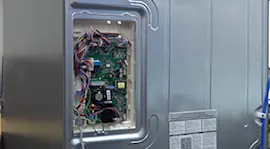
Installation guide
 Owner’s manual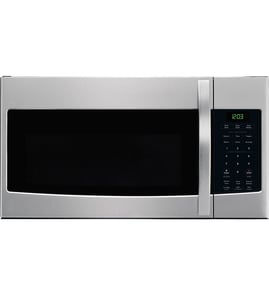


What is the life expectancy of a GE microwave?
A GE microwave like model JVM3160RF5SS typically lasts 7 to 10 years with normal household use. Heavy daily use, poor ventilation, and grease buildup can shorten lifespan; regular cleaning and proper airflow help it reach the upper end of that range.
- How often it runs (multiple heat cycles per day wears components faster)
- Ventilation and heat exposure (especially over a range or cooktop)
- Grease and moisture buildup in the cavity, door area, and venting
- Door use and alignment (slamming can stress latches and interlock switches)
- Power quality (surges can stress the control board and fuse)
Use the care and cleaning guidance in the JVM3160RF5SS owner’s manual.
- Wipe the cavity and door sealing surfaces regularly with mild soap and water
- Keep the bottom and vent area free of grease buildup
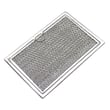
- Clean the metal vent filters about monthly (more often with frequent frying)
- Avoid running the microwave empty; it can stress internal components
- Use microwave-safe cookware to reduce arcing and interior damage
| Situation | What we recommend | Why |
|---|---|---|
| Unit is 0 to 5 years old | Repair is often worth it | More remaining service life |
| Unit is 6 to 10 years old | Compare repair cost to replacement | Higher chance of multiple wear items |
| Unit is over 10 years old | Replacement is often the better value | Major parts can exceed unit value |
If the microwave is completely dead (no display, no response), a common starting point is checking the microwave fuse WB27X11138 as part of a proper diagnostic.
Knowing the typical lifespan helps you decide whether to invest in parts like a fuse, door switch, or venting components, or plan for replacement before a no-heat or no-power failure interrupts daily cooking.
Last updated: January 2026
What type of appliance is a JVM3160RFSS?
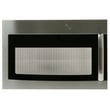
The GE JVM3160RF5SS is a microwave/hood combo, meaning it’s an over-the-range microwave oven that also works as a range hood with a vent fan and cooktop light. For operating features and safety basics, use the JVM3160RF5SS owner’s manual.
This appliance combines two functions in one unit:
- Microwave cooking in the oven cavity (turntable, control panel, power levels)
- Ventilation to remove steam, smoke, and odors from the cooktop below
- Lighting for the cooktop surface
- Mounting under a cabinet and against a wall (typical over-the-range installation)
Your GE JVM3160RF5SS can typically be set up one of these ways (depending on how it was installed):
| Venting setup | Where air goes | Common use case |
|---|---|---|
| Recirculating (ductless) | Back into the kitchen through a charcoal filter | No exterior duct available |
| Outside top exhaust | Up through ductwork | Cabinet or attic duct route |
| Outside back exhaust | Out through rear wall ductwork | Direct wall vent behind unit |
If your unit is ductless/recirculating, the charcoal filter is a normal maintenance item; the compatible replacement is the microwave charcoal filter WB02X11550.
Knowing it’s a microwave/hood combo helps you choose the right parts and maintenance steps. For example, “hood” symptoms (poor venting, grease buildup, loud fan) often involve filters or vent components, not the microwave heating system.
Last updated: January 2026
What kind of ventilation does JVM3160RFSS need?
The GE JVM3160RF5SS microwave/hood combo can be installed in one of three ventilation configurations: recirculating (ductless), outside top exhaust (vertical duct), or outside back exhaust (horizontal duct). The “right” choice depends on whether you have existing ductwork and want to vent air outdoors.
Here are the supported ventilation types called out in the installation instructions:
- Recirculating (non-vented/ductless): air is filtered and returned to the room
- Outside top exhaust: vents upward through the cabinet and out through ducting
- Outside back exhaust: vents straight out the back through the wall and ducting
For the step-by-step setup details, follow the JVM3160RF5SS installation guide.
| Vent type | Duct required | Where air goes | Typical use case |
|---|---|---|---|
| Recirculating | No | Back into kitchen | No exterior duct available |
| Outside top exhaust | Yes | Up and out | Existing vertical ducting |
| Outside back exhaust | Yes | Out through wall | Existing rear wall ducting |
- Existing duct location (top cabinet vs rear wall)
- Cabinet and mounting space (over-the-range installs must mount to the top cabinet and wall)
- Damper and duct fit (keep the duct run as direct as possible)
- Filter needs (recirculating setups use a charcoal filter)
If you are installing as recirculating and need the charcoal filter used on this model family, the microwave charcoal filter WB02X11550 is the compatible replacement part listed for JVM3160RF5SS.
Correct ventilation improves smoke and odor removal, helps manage heat and steam from the cooktop, and reduces grease buildup on the microwave vent filters and surrounding cabinets.
Last updated: January 2026