 Owner’s manual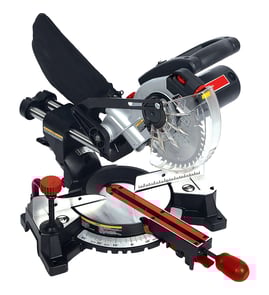

How to get a miter saw to lift up?
To lift the saw arm on your Craftsman 315212120 compound miter saw, press the arm down slightly to take pressure off the lock, then pull the lock pin out to release the arm; raise the arm to its full up position.
- Unplug the saw before adjusting anything near the blade or guard.
- Press the saw arm down slightly (this removes tension from the lock).
- Pull the lock pin out to release the arm from the transport position.
- Slowly raise the saw arm to its full raised position.
- If the arm will not move, check for sawdust buildup around the pivot and lock area.
A miter saw arm usually sticks because the lock pin is still engaged under load, or debris is binding the pivot/guard area.
- Lock pin under tension: push down a bit more, then pull the pin.
- Sawdust or pitch buildup: clean around the lock pin hole, pivot points, and guard path.
- Bent or damaged lock pin: inspect for a pin that will not slide smoothly.
- Dry pivot points: apply a light machine oil to pivots (avoid getting oil on the blade or belt area).
- Guard interference: confirm the blade guard moves freely and is not catching.
| Item | Purpose | When you use it |
|---|---|---|
| Lock pin | Holds the saw arm down in the transport (locked) position | Before carrying/storing; before some adjustments |
| Saw arm | The hinged arm that raises and lowers the blade | Every cut |
| Guard | Covers the blade as the arm moves | Always during operation |
Releasing the lock pin correctly prevents sudden arm movement and helps you avoid forcing the hinge mechanism, which can throw off alignment and make miter and bevel cuts less accurate.
For the exact location of the lock pin and the correct “push down then pull pin” motion for model 315212120, follow the diagrams and steps in the 315212120 owner's manual.
Last updated: February 2026
What kind of miter saw do I need for trim?
For most trim work, we recommend a compound miter saw with enough blade size and motor power to cut common casing, baseboard, and crown cleanly. The Craftsman 315212120 is a 12-inch compound miter saw with a 15-amp motor, which is a strong fit for typical trim and molding cuts (including compound angles).
- Blade size: A 10-inch saw handles most baseboard and casing; a 12-inch saw gives more crosscut capacity for wider trim.
- Motor power: For corded saws, 15 amps is a common, dependable target for trim and molding.
- Cut capacity: Make sure it can crosscut the width you actually use (wide baseboard, stair skirt, etc.).
- Miter and bevel range: Compound capability matters for crown molding and angled trim returns.
- Positive stops and lock strength: Solid miter detents and a secure lock reduce “almost-right” angles.
- Dust control: A dust guide or port helps keep your cut line visible.
According to the 315212120 owner's manual, this model includes a 12-inch blade and is designed for trim-style applications like moldings, door casings, and fine joinery.
| Trim task | What matters most | How this saw matches |
|---|---|---|
| Baseboard and casing | Clean 90° and 45° crosscuts | 12-inch blade, compound miter design |
| Crown molding (flat method) | Repeatable compound angles | Uses 33.85° bevel and 31.62° miter settings (typical 52°/38° crown) |
| Picture frame miters | Accurate miter stops | Positive stops at common angles |
- Clamp the saw securely to a bench before cutting.
- Clamp the workpiece on one side of the blade only to reduce binding and kickback.
- Tighten the miter lock handle firmly before every cut.
- Make a test cut in scrap before cutting finish trim.
- For fine trim or plastic molding, use a blade intended for fine finish cuts.
Trim shows every gap. A compound miter saw with stable locks, repeatable angle stops, and enough crosscut capacity helps you get tight corners, clean miters, and fewer do-overs.
Last updated: February 2026
What should you never cut with a miter saw?
You should never cut anything you cannot hold firmly and safely against the fence on your Craftsman 315212120 compound miter saw, and you should never make freehand cuts. Avoid materials and setups that can bind the blade or let the offcut move, because that leads to kickback and serious injury (the manual calls out these hazards clearly in the cutting safety rules).
- Freehand cuts (workpiece not flat on the miter table and tight to the fence).
- More than one piece at a time; never stack workpieces.
- Small pieces you cannot clamp; keep hands out of the marked “no hands zone.”
- A workpiece clamped on both sides of the blade; that can pinch the kerf and bind the blade.
- The “free scrap end” using a length stop; the loose end can catch and kick up.
- Anything not supported flat (bowed, twisted, or rocking stock) that will not sit firmly against the fence.
The 315212120 is intended for crosscutting wood and plastic with the correct blade and proper support. For other materials, use the correct tool and blade designed for that material.
| Material | Use this miter saw? | Notes |
|---|---|---|
| Wood (crosscuts, miters) | Yes | Keep it tight to the fence; clamp when needed. |
| Plastic | Yes | Use an appropriate blade; support the work to reduce chipping. |
| Metal | No | Use a saw and blade specifically designed for metal cutting. |
| Masonry/stone/tile | No | Abrasive cutting requires different tools and guarding. |
Kickback typically happens when the workpiece is not against the fence, gets dropped into the blade, or the blade binds because the kerf closes. Keeping one side of the blade free, using the fence as a backstop, and clamping correctly prevents the blade from grabbing and throwing the work.
- Lock the miter table and bevel (saw arm) before cutting.
- Let the blade reach full speed before contacting the work.
- Keep hands at least 3 inches from the blade path; never reach behind or under the blade.
- Release the switch and let the blade stop fully before raising it.
- Avoid awkward hand positions; keep solid balance and stance.
For the model-specific safety rules and diagrams, follow the 315212120 owner's manual.
Last updated: February 2026
Which Mitre saw is the most accurate?
The most accurate miter saw is the one that stays square and repeatable after setup. If you already own the Craftsman 315212120 compound miter saw, you get “most accurate” results by calibrating the blade-to-table and bevel positive stops exactly as shown in the owner's manual.
Accuracy is repeatability: the saw returns to true 0°, true 45°, and cuts square under normal feed pressure.
Key accuracy checkpoints:
- Blade square to the miter table at 0°
- Fence straight and square to the blade
- Miter detents (positive stops) landing on the marked angles
- Bevel positive stops set correctly
- Workpiece clamped firmly against the fence
- Sharp, appropriate blade for the material
Our best results come from doing the manual’s squaring procedure and then confirming with test cuts.
Do this setup routine:
- Lock the miter table at 0° and check blade-to-table squareness with a combination square
- If the blade is not square, adjust the bevel positive stop adjustment screw and locknut
- Recheck after tightening the bevel lock knob and locknut
- Make trial cuts in scrap before critical trim or frame cuts
- Clamp the work; keep hands outside the marked no-hands zone (at least 3 inches from the blade)
These specs help match the saw to the job; they do not guarantee accuracy by themselves.
| Spec | Craftsman 315212120 |
|---|---|
| Blade diameter | 12 in. |
| Arbor size | 5/8 in. |
| No-load speed | 4000 RPM |
| Electrical rating | 120V, 60 Hz AC |
| Motor current | 15A |
| Max cut at 0° miter / 0° bevel | 7-7/8 in. x 2-1/2 in. |
A tuned compound miter saw produces tight-fitting miters and square crosscuts with less rework. Calibration, clamping, and blade condition drive accuracy more than brand name alone.
Last updated: February 2026