- Kenmore refrigerator water filters
- Whirlpool refrigerator water filters
- Samsung refrigerator water filters
- GE refrigerator water filters
- LG refrigerator water filters
- Frigidaire refrigerator water filters
- KitchenAid refrigerator water filters
- Maytag refrigerator water filters
- Kenmore Elite refrigerator water filters
- Estate refrigerator water filters
- GE Profile refrigerator water filters
- Amana refrigerator water filters
- Bosch refrigerator water filters
- Dacor refrigerator water filters
- Electrolux refrigerator water filters
Top DIY repair help
View All Repair Categories
Appliances
Lawn & Garden
Power Tools
Home Improvement
Sports & Leisure
Heating & Cooling
How to find the age of your Craftsman riding lawn mower or lawn tractor
less than a minute readJan 09Lyle Weischwill
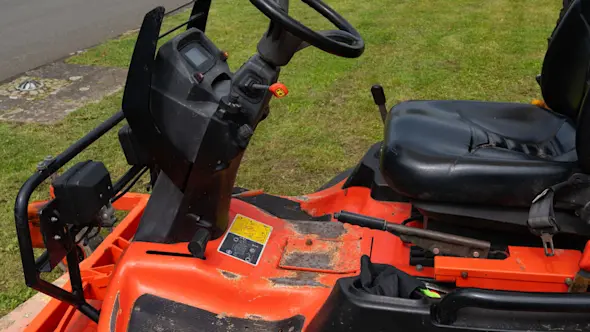
Knowing how old your Craftsman riding lawn mower or lawn tractor is can help you decide what’s worth fixing and what isn’t. Larger machines see more wear over time, and age plays a role in expected reliability and long-term value. With that information in hand, you’re better equipped to make informed decisions.
Craftsman riding mowers and lawn tractors don’t use one universal date code. Instead, you’ll need to decode the serial number on the model plate. How you do that depends on the first three digits of the model number. Find that prefix first, then decode the serial number using the format tied to it.
Where to locate the model and serial number on a riding mower
Start by locating the model and serial number label on your Craftsman riding lawn mower or lawn tractor. On most models, both numbers appear together on the same tag.
Common locations include:
Under the seat
On the frame beneath the seat platform
Near the engine mounting area
On the rear frame of the tractor
The model number usually starts with three digits, followed by a decimal point and then five to eight more digits. Those first three digits determine which serial number format you’ll use to find the production date.
If your model number starts with 917
Craftsman lawn and garden products with model numbers starting with 917 don’t all use the same serial number format. The production date is encoded in different ways depending on when the unit was built, so the first step is identifying how the serial number begins.
Match your serial number to one of the formats below.
How the serial number encodes the build date
Serial format: year and week
If the serial number starts with four digits, it may follow this pattern:
YYWWxxxxx
First two digits = year
Next two digits = week of manufacture
Example:
0423xxxxx = week 23 of 2004
Serial format: calendar date
Some products use a serial number that starts with six digits that resemble a date:
MMDDYYxxxxx
First two digits = month
Next two digits = day
Next two digits = year
Example:
061508xxxxx = June 15, 2008
Serial format: extended date format
Other products use a longer serial number format:
YYYYWWDxxxx
First four digits = year
Next two digits = week
Next digit = day of the week
When the serial number doesn’t fit a clear pattern
If the serial number doesn’t clearly match one of these formats, the engine manufacture date is often the most reliable way to estimate when the machine was built. In most cases, the engine is produced shortly before final assembly.
For model numbers beginning with 247
Craftsman lawn and garden products with model numbers starting with 247 typically use an 11-character serial number made up of letters and numbers. The production date is encoded near the beginning of the serial number.
Focus on the first five characters.
Serial number structure used on these machines
Many serial numbers follow this pattern:
PMDDYxxxxx
First character = product type
Second character = month (letter)
Third and fourth characters = day of the month
Fifth character = year
The month is shown as a letter:
| Letter | Month | Letter | Month |
|---|---|---|---|
| A | January | G | July |
| B | February | H | August |
| C | March | I | September |
| D | April | J | October |
| E | May | K | November |
| F | June | L | December |
Example:
Serial number:
1F030xxxxxx
F = June
03 = 3rd day of the month
0 = year ending in 0
This indicates June 3 in a year ending in 0. Depending on the tractor, that could be 2000 or 2010. Use the machine’s design, features, and labeling to determine which year fits.
Newer serial numbers (2021 and later)
Beginning in 2021, some models switched from a numeric year character to a **letter-based year code**.
M = 2021
N = 2022
P = 2023
Q = 2024
R = 2025
If the year character is a letter instead of a number, the serial number was produced **2021 or later**, removing decade ambiguity.
If the date is still uncertain
If the serial number doesn’t match the expected pattern, or the year could fall in more than one decade, use the engine manufacture date as a secondary reference point.
If the model number begins with 536
Craftsman lawn and garden products with model numbers starting with 536 often use a serial number format where the production date is embedded in the first four digits.
How to interpret the serial number
If the serial number begins with four digits, it may follow this pattern:
YDDDxxxx
First digit = year (last digit of the year)
Next three digits = day of the year
Example:
5123xxxx = 123rd day of a year ending in “5”
That could indicate 1985, 1995, or 2005. Use the tractor’s styling, features, and labeling to determine which year makes sense.
Why the engine date is especially useful
Because this format only shows the last digit of the year, confirming the decade requires judgment. The engine manufacture date often provides the clearest reference, since engines are typically installed shortly before final assembly.
Confirm the build timeframe
After decoding a production date, it’s worth confirming that it aligns with what you see on the mower or tractor.
Helpful checks include:
Whether the date fits the machine’s design and control layout
Whether the engine manufacture date precedes the estimated equipment date; may be less reliable if the engine was replaced.
Whether decals, safety labels, and features match that era
If something doesn’t line up, revisit the serial number format before settling on a final answer.