Owner’s manual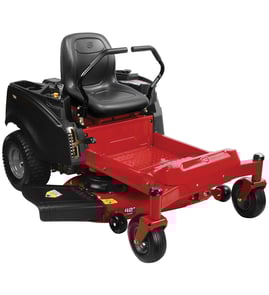

How steep is too steep for a riding mower?
For the Swisher ZT18542 zero-turn riding lawn mower, anything over a 15-degree slope is too steep to mow. Operating beyond that limit increases the risk of traction loss, sliding, and a rollover; we follow the slope-operation limit listed in the ZT18542 owner's manual.
Quick slope limit for this model
The manual’s slope guidance is clear for the ZT18542:
| Item | Guidance for Swisher ZT18542 |
|---|---|
| Maximum slope to operate on | 15 degrees |
| Safer mowing direction on slopes | Up and down the slope |
| Higher-risk direction | Across the slope (overturn risk) |
How to mow slopes more safely
When you are close to that 15-degree limit, use these practices to reduce risk:
- Mow up and down the slope; avoid mowing across it.
- Avoid sudden turns; keep both drive wheels moving slightly during turns.
- Do not mow wet grass; reduced traction can cause sliding.
- Stay away from ditches, drop-offs, and embankments; edges can collapse.
- If you feel uneasy on the slope, do not mow it.
How to estimate slope (degrees) in the yard
If you do not have a slope meter, a simple check helps you decide quickly:
- Measure rise (vertical change) over a run (horizontal distance).
- A 15-degree slope is about a 27% grade (roughly 27 inches of rise over 100 inches of run).
| Slope | What it means in the yard |
|---|---|
| 10° | Moderate incline; still use caution |
| 15° | ZT18542 maximum; treat as a hard limit |
| 20°+ | Too steep for this mower; use different equipment |
Why it matters
Rollover risk increases fast on slopes because the mower’s center of gravity shifts and traction drops, especially during turns or on wet grass. Staying at or under the ZT18542’s 15-degree limit helps protect you, the mower deck, and the hydro drive system.
Last updated: February 2026
How to manually push a zero turn mower?
To manually push your Swisher ZT18542 zero-turn riding lawn mower, you open the transmission bypass valves so the hydrostatic drive releases. Set the parking brake, put the steering levers in neutral, then move the two transmission valve levers behind the mower to the push position.
Steps to push the mower safely
- Park on a flat, level surface and remove the key.
- Disconnect the spark plug wire so the engine cannot start accidentally.
- Put the steering levers in the neutral locked position.
- Set the parking brake.
- From behind the mower, push in on each transmission valve lever until it stops, then rotate each lever to the locked (left) position (this is the bypass/push setting).
- Release the parking brake and carefully push the mower forward or backward.
For the exact lever location and the correct lever positions for your ZT18542, use the ZT18542 owner's manual.
What to do after you move it
Before mowing again, return the mower to normal drive mode.
- Set the parking brake.
- Rotate both transmission valve levers back to the drive position.
- Verify the levers move freely and match side-to-side.
- Reconnect the spark plug wire.
- Start the mower and test slow forward and reverse movement in an open area.
Quick reference: push mode vs drive mode
| Mode | Transmission valves | What you can do |
|---|---|---|
| Push mode (bypass) | Open/bypassed | Push the mower by hand |
| Drive mode | Closed/engaged | Mower drives normally with steering levers |
Why it matters
Hydrostatic transaxles resist rolling when engaged. Opening the bypass valves prevents damage to the drive system and makes it much easier to move the mower when it will not start or needs repositioning.
Last updated: February 2026
What is the difference between a front engine and rear engine riding mower?
A front-engine riding mower puts the engine in front of the operator and is commonly used for general mowing plus light towing. A rear-engine riding mower places the engine behind the operator; it is typically more compact and is mainly designed for mowing rather than heavy hauling.
Quick comparison
| Feature | Front-engine riding mower | Rear-engine riding mower |
|---|---|---|
| Engine location | In front of the operator | Behind the operator |
| Typical best use | Mowing plus light towing and yard tasks | Mowing and tight-yard maneuvering |
| Operator view | Clear view forward, longer hood | More open view ahead, shorter front |
| Common feel | More like a small tractor | More compact, lawn-focused |
What this means for your Swisher ZT18542
The Swisher ZT18542 is a zero-turn riding lawn mower, so it is built around maneuverability and blade engagement control (PTO) rather than pulling heavy tow-behind equipment. For safe operation, we recommend following the starting and control steps in the ZT18542 owner's manual.
Practical buying and usage tips
- If you plan to tow frequently (cart, dethatcher, spreader), choose a mower designed and rated for towing; check the hitch and towing limits in the manual.
- For mowing-only performance, focus on deck condition, belt condition, and correct deck leveling.
- Keep the operator presence system working properly; it is a key safety feature.
- Use full throttle for mowing and battery charging as directed for best performance.
- Level the deck correctly to improve cut quality and reduce scalping.
Why it matters
Choosing the right engine layout affects how the mower handles, what attachments it can realistically manage, and how comfortable it feels in your yard. For the ZT18542, correct control use (parking brake, throttle/choke, PTO switch, neutral lock) and deck setup have the biggest impact on results.
Last updated: February 2026
Is it worth repairing a lawn mower engine?
Yes, it’s worth repairing the engine on your Swisher ZT18542 when the problem is external and serviceable (fuel delivery, ignition, wiring, belts, or a safety switch). When the engine has major internal damage or the mower has been dropped, damaged, or is vibrating excessively, replacement is usually the better value and safer choice; use the owner's manual for inspection and safety steps.
Quick decision checklist
- Repair makes sense when it’s a no-start, rough idle, or power loss tied to fuel, spark, or airflow.
- Repair makes sense when the mower runs smoothly and has no abnormal vibration.
- Replace the engine (or retire the mower) when there’s knocking, low compression, heavy smoke, or metal in the oil.
- Replace the engine when repair cost approaches about half the cost of a comparable mower.
- Stop and inspect first if you hit an object; fix damage before restarting.
- Do not keep operating if the mower was dropped, damaged, or vibrates excessively.
What “minor” vs “major” usually looks like
| Symptom | Most likely category | Typical path |
|---|---|---|
| Won’t start, fuel smell | Fuel system (carburetor, fuel line, stale gas) | Repair/clean/replace service parts |
| Cranks but no spark | Ignition or safety interlock | Diagnose switches, coil, wiring |
| Runs but shakes hard | Blade/spindle/deck damage or bent crank | Inspect; often replacement if crank is bent |
| Loud knock, loss of power | Internal wear (piston, rod, crank) | Engine replacement is usually best value |
Why it matters (cost and safety)
A zero-turn riding lawn mower puts high load on the engine and drivetrain. Continuing to run with excessive vibration or after impact damage can quickly turn a small repair into a bigger failure, and it increases the risk of unsafe operation.
Safety notes we follow before deciding
- Shut off blades and stop the engine before leaving the machine.
- Never make adjustments or repairs with the engine running.
- If you strike an object, stop and inspect; repair as needed before restarting.
- Avoid slopes over 15 degrees; instability and overturn risk can complicate diagnosis and testing.
Last updated: February 2026
What is the advantage of a rear engine mower?
A rear-engine mower like the Swisher ZT18542 concentrates weight toward the rear, which improves drive-wheel traction and helps the mower feel planted while turning. The layout also supports a compact, maneuverable design that works well around trees, beds, and tight obstacles.
Key advantages you will notice
- Stronger traction on grass because more weight sits over the drive wheels
- Stable handling during turns, especially on flat lawns
- Compact footprint that fits and turns in tighter areas
- Good control around obstacles when you use smooth steering inputs
- Easier routine checks when you follow the access points shown in the ZT18542 owner's manual
How to use those advantages while mowing (ZT18542 basics)
The manual emphasizes controlled operation and practicing in an open, flat area because this mower is designed to be very maneuverable. For mowing, use the throttle and PTO steps in the sequence shown in the manual.
- Set the deck height before you start mowing
- Start the engine with the parking brake engaged and controls in the proper start position
- Bring the throttle to about halfway, then engage the PTO
- After the blades are engaged, move the throttle to full throttle for mowing performance and battery charging
- Keep the deck clear of grass buildup to help protect the PTO belt
Quick reference: throttle and PTO sequence
| Step | Control action | Why it matters |
|---|---|---|
| 1 | Throttle about halfway | Prepares for smooth PTO engagement |
| 2 | Engage PTO | Starts blade rotation |
| 3 | Throttle to full throttle | Delivers best cutting performance and charging |
Why it matters
Rear-engine traction and high maneuverability can reduce trimming time and improve cut consistency, but only when you use steady speeds, correct throttle sequence, and keep the deck from plugging.
Last updated: February 2026