
How fast is a 400cc go kart go?
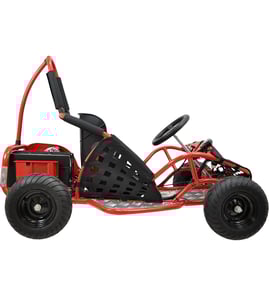
A 400cc go-kart typically tops out around 40 to 70+ mph, depending on gearing, tire size, drivetrain type (CVT vs. chain), terrain, and rider weight. That speed range is not specific to the Manco 495B, because “495B” is a model number, not an engine size.
Typical 400cc speed ranges (real-world)
- Trail/off-road kart or buggy: 40 to 55 mph
- Sport or performance setup: 55 to 70+ mph
- Speed-limited setups: often under 40 mph
- Soft terrain (sand, mud) or hills: lower top speed
- Taller tires or taller gearing: higher top speed (usually slower acceleration)
What determines top speed most
Top speed is mainly a math and setup problem, not just displacement:
- Final drive ratio (front sprocket vs. rear sprocket tooth count)
- Tire diameter (bigger tire equals more speed per engine RPM)
- Clutch/CVT condition (slip kills speed and creates heat)
- Engine RPM limit or governor (if equipped)
- Brake drag and bearing condition (rolling resistance)
Quick reference table
| Change | Usually increases top speed | Usually decreases top speed |
|---|---|---|
| Gearing | Smaller rear sprocket (taller gearing) | Larger rear sprocket (shorter gearing) |
| Tires | Larger diameter | Smaller diameter |
| Drivetrain health | Free-rolling, no slip | Slipping clutch/CVT, brake drag |
How to estimate your own kart’s speed
- Measure rear tire diameter.
- Identify sprocket tooth counts.
- Use a GPS-based speed reading in a safe area.
- If you are troubleshooting a speed limiter, ignition cutout, or charging issue, use how to use a multimeter to test electrical parts video.
Why it matters
A kart that can go faster must also stop and steer safely at that speed. We prioritize brakes, throttle return, steering play, and tire condition before making gearing or tire changes.
Last updated: February 2026
What are the most common issues with 495B?
The most common problems we see on the Manco 495B go-kart are no-start or poor running, weak drive or slipping, braking issues, and steering or handling looseness. These usually trace back to fuel delivery, ignition, chain and clutch wear, brake adjustment, or loose chassis hardware.
Common symptoms and what they usually point to
- Engine will not start: stale fuel, clogged carburetor jets, fouled spark plug, kill switch wiring issue
- Starts but runs rough or dies: dirty carburetor, air leak, restricted fuel flow, incorrect idle mixture
- Poor acceleration or kart will not move well: worn clutch, loose chain, misaligned sprockets
- Chain noise or chain keeps coming off: incorrect tension, worn sprocket teeth, bent axle or misalignment
- Weak brakes or pulling: worn pads/shoes, contaminated friction surfaces, cable stretch, out-of-adjustment linkage
- Loose steering or wandering: worn tie-rod ends, loose kingpins, low tire pressure, bent components
Quick checks we recommend first (10 to 20 minutes)
- Verify the kill switch is in RUN and the wiring is intact (no pinched or broken leads).
- Drain old fuel; refill with fresh fuel and confirm the fuel shutoff (if equipped) is open.
- Pull and inspect the spark plug; replace if fouled and set the correct gap for your engine.
- Check chain tension and alignment; adjust so it has slight slack and runs straight on the sprockets.
- Inspect the centrifugal clutch for blueing, glazing, or excessive play.
- Test brakes at low speed; adjust the cable/linkage so the wheels lock evenly.
What to inspect based on the symptom
| Symptom | Most likely area | Typical fix |
|---|---|---|
| No start | Fuel or ignition | Clean carburetor, replace plug, repair switch wiring |
| Slips under load | Clutch or chain | Replace clutch, set chain tension, align sprockets |
| Won’t stop well | Brake system | Replace friction parts, adjust cable, clean drum/rotor |
| Wanders | Steering/tire | Tighten hardware, replace worn joints, set tire pressure |
Why it matters
A 495B is a simple machine, but worn drive and brake parts can quickly turn into unsafe handling. Catching chain, clutch, and brake issues early prevents damage to sprockets, axles, and hubs.
For help matching the correct replacement parts to your exact 495B configuration, use your model number and diagrams on Sears PartsDirect.
Last updated: March 2026
What is special about 495B?
For the Manco 495B go-kart, what’s special is that 495B is the model identifier used to match the correct frame, steering, brake, and drivetrain parts to your kart. It is not a performance rating; it is the key detail we use to help you get the right replacement parts and diagrams.
What “495B” tells us (and what it does not)
- It identifies a specific Manco go-kart design and parts breakdown.
- It helps narrow down compatible components like wheels/tires, throttle parts, and brake hardware.
- It does not tell engine size or top speed by itself (many karts get engine swaps).
- It does not refer to the math concept “495” (Kaprekar’s constant); that is unrelated to go-karts.
How to confirm you have a Manco 495B
Check for a model tag or stamping and compare it to the parts diagrams for the 495B.
Common places to look:
- Rear frame rail near the engine plate
- Seat area or under the seat pan
- Steering column support area
- Any original ID plate riveted to the frame
Quick comparison: model number vs. other identifiers
| Identifier | Example | What it’s used for | Why it matters |
|---|---|---|---|
| Model number | 495B | Finding the correct parts list/diagrams | Prevents ordering mismatched parts |
| Engine model | (varies) | Engine-specific parts (carb, recoil, governor) | Engines are often changed over time |
| Tire size | (varies) | Tires, tubes, wheels | Affects fit and ride height |
| Chain pitch | #35 or #40 (typical) | Chain and sprockets | Wrong pitch will not mesh |
Why it matters
Go-karts are frequently modified over the years. Using the Manco 495B model number keeps your repair focused on the kart’s original chassis and hardware so steering, brakes, and drivetrain parts fit correctly.
For help locating and confirming the model number before ordering, use how to find your appliance model number (and what it means for parts).
Last updated: February 2026