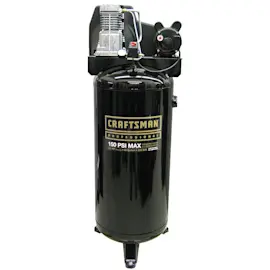
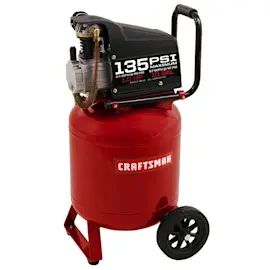
Owner’s manual

What is the most common cause of air compressor failure?
The most common cause of failure on a Craftsman air compressor like model 921169130 is poor maintenance that leads to overheating and accelerated wear (especially when airflow is restricted or the unit is run hard). Electrical supply issues (low voltage, undersized extension cords) and air leaks are also frequent contributors; our owner's manual covers key safety and maintenance basics.
Top causes we see most often
- Overheating from poor ventilation: running in a hot, dusty, or poorly ventilated area.
- Electrical supply problems: not using a dedicated 15-amp circuit, using the wrong extension cord gauge/length, or low voltage stressing the motor.
- Moisture left in the tank: condensation buildup when the tank is not drained after use.
- Air leaks: leaks at fittings, the check valve, or the safety/relief valve that make the pump run longer and hotter.
- Overuse for the application: air demand higher than the compressor can supply, causing excessive run time.
Quick checks that prevent most breakdowns
- Shut off and unplug the compressor before inspecting anything.
- Confirm airflow: keep the unit in a clean, dry, well-ventilated spot.
- Drain the tank after use to remove condensation.
- Listen for leaks after shutdown (hissing at the relief valve can point to a check valve issue).
- Verify power setup: dedicated 15-amp circuit; if you must use an extension cord, use 12-gauge and keep it 25 ft max.
Common symptoms and what they usually mean
| Symptom | Most likely cause | What to do first |
|---|---|---|
| Won’t start or trips | Low voltage, overload, poor ventilation | Let it cool 10 minutes, check circuit/cord setup |
| Runs but won’t build pressure | Leak, check valve issue, demand too high | Check for leaks, confirm tool CFM needs |
| Constant hissing after shutdown | Check valve not sealing | Drain tank, clean/replace check valve |
| Water at the air outlet | Normal condensation, high humidity | Drain tank, consider an in-line water filter |
Why it matters
Most “failures” start as small issues that force longer run time. Longer run time increases heat, and heat shortens motor and pump life. Keeping voltage stable, airflow open, and the tank drained prevents the most common wear-out patterns.
For step-by-step troubleshooting by symptom, use our air compressor resources on Sears PartsDirect.
Last updated: February 2026
Is it worth it to repair a compressor?
For the Craftsman 921169130 air compressor, it’s worth repairing when the problem is a normal service item (pressure switch, check valve, leaks, or a no-start issue). It’s not worth repairing if the air tank is damaged or leaking; the manual directs you to discontinue use because the tank cannot be repaired.
Quick decision checklist
- Repair it if the unit won’t start, won’t build pressure, leaks air, or won’t regulate output pressure.
- Do not repair the tank if it has a leak, severe corrosion, or physical damage; stop using the compressor.
- Repair it if the motor shut off from overheating; let it cool and correct the cause (low voltage, airflow, duty cycle).
- Repair it if the safety valve fails the pull-ring test (it should re-close around 40 to 50 PSI).
- Replace the unit if multiple major components are failing at once and repair cost approaches replacement cost.
What “not worth repairing” means on this model
The most important line in the Craftsman 921169130 guidance is about the air tank: if the tank develops a leak, the tank is not repairable and the compressor should be discontinued.
Why the tank is different
A leaking or weakened tank is a pressure vessel risk. The manual also warns not to drill, weld, or modify the tank.
Common repairable problems (and where to start)
Use these symptom paths to narrow the likely part or adjustment:
- Won’t start: air compressor won't start
- Won’t build tank pressure: air compressor won't build tank pressure
- Air leaks: air compressor air leaks
- Can’t adjust output pressure: air compressor can't adjust the output air pressure
Typical “repair vs replace” cost logic
| Situation | Usually worth repairing? | Why |
|---|---|---|
| Single failure (switch, valve, fitting leak) | Yes | Targeted fix, limited labor |
| Repeated overheating trips | Yes | Often electrical/ventilation/usage related |
| Tank leak or tank damage | No | Tank is not repairable |
| Several major failures at once | No | Cost and downtime add up |
Why it matters
A good repair restores safe cut-in/cut-out operation, stable tank pressure, and reliable tool performance. A bad repair decision (especially involving the tank) can create a serious safety hazard.
For parts lookup by model and diagrams, start with the Craftsman 921169130 parts list, or search by model on Sears PartsDirect. For operating limits, maintenance intervals, and safety checks, use the owner's manual.
Last updated: February 2026
What are the 4 types of compressors?
The four main compressor types are reciprocating (piston), rotary screw, centrifugal, and axial. Your Craftsman air compressor model 921169130 is a reciprocating, oil-free direct-drive style, which is common for powering tools and general shop use; see the owner's manual for model-specific specs and safety rules.
The 4 compressor types (what they mean)
- Reciprocating (piston): Uses a piston and cylinder to compress air in strokes; common in portable and shop compressors.
- Rotary screw: Uses two intermeshing screws for continuous compression; common in commercial and industrial settings.
- Centrifugal: Uses a high-speed impeller to add velocity and convert it to pressure; used for high-volume applications.
- Axial: Uses multiple rotating and stationary blade stages; typically used in very large, specialized systems.
Quick comparison
| Type | How it compresses | Typical best use | Typical strengths |
|---|---|---|---|
| Reciprocating (piston) | Piston strokes | Home, garage, intermittent use | Lower cost, simple design |
| Rotary screw | Rotating screws | Shops, continuous demand | Smooth output, high duty use |
| Centrifugal | Impeller (dynamic) | High airflow facilities | High volume, efficient at scale |
| Axial | Blade stages (dynamic) | Specialized large systems | Very high flow in compact stages |
Why it matters for your 921169130
Compressor type affects noise, duty cycle, and how the unit builds pressure. For this Craftsman 921169130, the manual calls out key operating limits and specs that match a piston-style unit:
- Oil-free direct drive pump (lower maintenance, different wear pattern than oil-lubricated)
- 50% duty cycle (run up to about 30 minutes per hour)
- Cut-in around 120 PSI; cut-out around 150 PSI
- 20-gallon tank capacity
Helpful next steps (especially if you are troubleshooting)
- Confirm your compressor’s cut-in/cut-out behavior and duty cycle limits in the owner's manual.
- If it struggles to start, use our guide: air compressor won't start.
- If it will not build pressure, use: air compressor won't build tank pressure.
- If pressure control is inconsistent, use: air compressor can't adjust the output air pressure.
- For parts lookup by model number, start with the parts list for 921169130 or search on Sears PartsDirect.
Last updated: February 2026
Will a 100 PSI air compressor run an impact wrench?
Yes, 100 PSI is enough to run most pneumatic impact wrenches because many are rated around 90 PSI at the tool. For the Craftsman 921169130, the key is air delivery and recovery: it’s rated 3.8 SCFM at 90 PSI with a 20-gallon tank, so it’s best for intermittent bursts rather than nonstop hammering.
What to match on the impact wrench label
Look at the wrench’s required SCFM at 90 PSI (or CFM at 90 PSI). If the tool’s requirement is higher than the compressor’s output, the wrench will lose torque as tank pressure drops.
- Check the tool’s SCFM/CFM @ 90 PSI requirement
- Set the regulator to the tool’s rated pressure (commonly 90 PSI)
- Use a larger air hose (often 3/8-inch) and high-flow couplers to reduce restriction
- Let the tank fill completely before starting heavy work
- Plan pauses so the compressor can recover between bursts
Craftsman 921169130 capability snapshot
| Item | What it means for an impact wrench |
|---|---|
| 3.8 SCFM @ 90 PSI | Runs light to medium impacts in bursts; struggles with continuous use |
| 20-gallon tank | Longer bursts before pressure sag; still limited by SCFM |
| Cut-in 120 PSI / cut-out 150 PSI | Good stored pressure; regulator still controls tool PSI |
| 50% duty cycle (30 min per hour) | Prevents overheating during repeated cycling |
Setup steps we recommend
- Fill the tank to shut-off pressure.
- Connect the hose to the quick connect.
- Adjust the regulator to the wrench’s recommended PSI.
- Test under load; if torque fades quickly, the limiting factor is SCFM, hose size, or fittings.
For operating details, regulator and gauge use, and duty-cycle guidance, follow the owner's manual.
Why it matters
Impact wrenches consume air in pulses; when the compressor cannot keep up, pressure at the tool drops and torque falls off fast. Matching SCFM at 90 PSI is the most reliable way to get consistent performance.
If you need replacement parts or want to look up accessories by model number, start with the parts list for Craftsman 921169130 or search on Sears PartsDirect.
Last updated: February 2026