Installation guide
 Owner’s manual
 Error Codes




How to do a hard reset on a Kenmore washer?
For Kenmore Elite washer model 11027092603, a hard reset is simple: unplug the washer (or switch off the breaker) for 1 to 2 minutes, restore power, then press POWER and start a new cycle. This clears many temporary control glitches.
- Press STOP twice to end any active cycle and turn the washer off.
- Unplug the power cord (or turn the circuit breaker off).
- Wait 1 to 2 minutes.
- Restore power.
- Press POWER, select a cycle, then press START (the lid must be closed to start).
These steps help confirm whether the issue is a control hiccup or a real operating problem.
- Make sure the lid closes fully and the Lid Lock light behavior is normal.
- Try a different cycle selection and press START again.
- If the washer will not start, pause, or unlock correctly, inspect the lid lock area for obstruction.
- If the washer is shaking or stopping due to imbalance, re-level the washer and redistribute the load.
| Symptom after reset | Most common cause | What to do next |
|---|---|---|
| Won’t start | Lid not closed or lid lock issue | Close lid firmly; retry POWER then START |
| Stops mid-cycle | Load out of balance | Redistribute load; verify leveling |
| Error code returns | Underlying fault still present | Use model-appropriate error code guidance |
A hard reset restores the control to a clean startup state, which is often enough to clear false error conditions after a power flicker or an interrupted cycle. If symptoms return immediately, the washer is usually reacting to a real condition (lid lock, balance, draining, or a component issue).
For cycle and control-button details specific to this washer, use the 11027092603 owner’s manual. For error-code troubleshooting that applies to many Kenmore 110-series washers, use Kenmore 110 vmax top load washer error codes.
Last updated: January 2026
How many cubic feet is my Kenmore Elite washer?
The exact tub capacity (cubic feet) for Kenmore Elite washer model 11027092603 is listed on the model’s product specifications in the 11027092603 owner's manual. If you do not see it there, use the basket measurements method below to estimate capacity accurately for your washer.
Check the sections commonly labeled Specifications, Features, or Washer dimensions/capacity in the 11027092603 owner's manual. Capacity is usually shown as cu ft.
If you need a working number for comparing washers or choosing load size, you can estimate tub capacity from the inside basket dimensions.
- Unplug the washer for safety.
- Measure the inside diameter of the basket (in inches).
- Measure the usable depth from the bottom to just below the top rim (in inches).
- Use the formula below.
- Round to the nearest tenth for a practical estimate.
Treat the basket like a cylinder:
| What you measure | Symbol | Example unit |
|---|---|---|
| Basket inside diameter | D | inches |
| Usable basket depth | H | inches |
| Estimated capacity | Cu ft | cubic feet |
Estimated cu ft = (3.1416 × (D/2)² × H) ÷ 1728
Most Kenmore Elite top-load washers of this design fall in a roughly 3.2 to 4.5 cu ft range, depending on basket size and model series. Use the manual value when you need the exact number.
Capacity affects how much laundry you can wash per load, how well items circulate for cleaning, and how much HE detergent you should use. Overloading can also contribute to out-of-balance spinning and extra vibration.
Last updated: January 2026
How to force a Kenmore Elite washer to drain?
To force-drain a Kenmore Elite washer model 11027092603, we recommend canceling the cycle and running a Drain/Spin (or Spin/Drain) cycle first; if it still will not drain, remove standing water manually and then check the drain hose and drain pump for a clog. See the steps in the 11027092603 installation guide.
- Press Pause/Cancel (or Stop) to end the current cycle.
- Select Drain/Spin (or Spin/Drain) and start the cycle.
- If the tub is full, unplug the washer before any hands-on checks.
- Verify the drain hose is not kinked, crushed, or pushed too far into the standpipe.
- Make sure the standpipe or laundry tub can accept water fast enough.
- Unplug the washer.
- Bail or siphon water into a bucket or shallow pan (this prevents a big spill when hoses are opened).
- Inspect the drain hose path from the washer to the standpipe for a blockage.
- If the hose is clear, the most common next suspect is the drain pump.
| Symptom | Most likely area | What to check first |
|---|---|---|
| Hums but no water leaves | Drain pump | Debris in pump inlet or impeller |
| Drains slowly | Drain hose or standpipe | Kink, lint buildup, restricted standpipe |
| Stops and will not spin out | Lid lock or drain issue | Lid lock engagement, pump operation |
If you determine the pump is not moving water and the hose is clear, replacing the drain pump is a typical repair for this symptom; use the exact model-matched part pump-water W10536347.
Correct drain hose setup matters because a hose pushed too far down the standpipe can cause siphoning or poor draining. For this washer, keep the drain hose insertion shallow and secured.
- Use the drain hose form and secure it with the tie strap.
- Do not insert the drain hose too far into the standpipe.
- Level the washer to reduce vibration that can shift the hose during spin.
A washer that cannot drain usually cannot spin properly, so clothes stay soaking wet and the machine can stop mid-cycle. Fixing the hose setup or clearing a pump obstruction restores normal draining and protects the drive system from strain.
Last updated: January 2026
What is the average lifespan of a Kenmore washer?
A Kenmore washer typically lasts 10 to 15 years. For the Kenmore Elite washer model 11027092603, lifespan depends most on installation (leveling), detergent use, and routine cleaning; following the care steps in the 11027092603 owner's manual helps you reach the upper end of that range.
Most Kenmore washers fall into these real-world averages:
| Washer type | Typical lifespan | What usually ends it first |
|---|---|---|
| Top-load (HE, direct drive) | 12 to 15 years | Drive system wear, suspension issues |
| Front-load | 10 to 12 years | Bearings, door boot leaks, drain issues |
| High-use households | 8 to 12 years | Faster wear on bearings, pump, lid/lock |
We see the biggest longevity gains when you focus on the basics:
- Keep the washer level and stable to reduce vibration and tub wear (leveling guidance is in the 11027092603 installation guide).
- Use only HE detergent and avoid over-dosing; excess suds can stress the drain system.
- Run the Clean Washer cycle about once a month to reduce odor and residue buildup.
- Avoid chronic overloading; keep items below the top of the basket.
- Address small leaks or unusual noises early to prevent secondary damage.
These are frequent wear items on many Kenmore Elite washers, especially as they age:
- Drain pump (slow drain, grinding, or no-drain symptoms): pump-water W10536347
- Lid lock (won’t start, lid won’t lock/unlock): washer lid lock WPW10619844
- Suspension (excessive shaking, out-of-balance): suspension W10820048
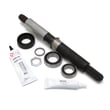
- Tub bearing/shaft wear (roaring during spin, wobble): whirlpool washer tub bearing and drive shaft kit W10435302
A washer that is out of level, over-sudsing, or running with early bearing or pump symptoms often develops bigger failures sooner. Good setup and monthly cleaning reduce vibration, residue, and strain on the drive and drain systems.
Last updated: January 2026