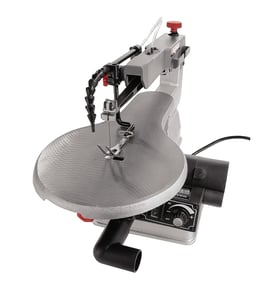

How do I change the blades on a scroll saw?
To change the blade on your Craftsman 31517290 scroll saw, unplug the saw, release blade tension, remove the old blade from the upper and lower clamps, then install a new blade with the teeth pointing down (most blades cut on the downstroke) and re-tension it.
- Unplug the scroll saw and wait for the blade to stop completely.
- Raise the hold-down foot or guard (if equipped) so you can access the blade area.
- Release blade tension using the tension knob/lever.
- Loosen the upper and lower blade clamp screws and remove the old blade.
- Insert the new blade into the lower clamp first, then the upper clamp.
- Set blade direction: teeth point down toward the table on most scroll saw blades.
- Tighten both clamp screws firmly, then re-apply tension.
- Pluck the blade lightly; it should sound tight and not flutter.
- Spin the saw by hand briefly (if your design allows) to confirm the blade clears the table insert.
- Make a short test cut on scrap wood; the blade should track straight without excessive vibration.
| Blade type | Best for | Notes |
|---|---|---|
| Pinned | Thicker stock, faster changes | Common on entry-level saws; limited for tight inside cuts |
| Pinless (plain-end) | Fine detail work, inside cuts | Requires compatible clamps/adapters |
| Spiral | Cutting in any direction | Rougher edge; more sanding |
Correct blade direction and proper tension reduce burning, wandering cuts, and broken blades. A blade installed upside down often cuts poorly and can pull the workpiece upward, which feels unsafe and ruins accuracy.
If you need blade clamps, a tensioning component, or other replacement parts for the Craftsman 31517290, start with the model parts list, or search by model number on Sears PartsDirect.
Last updated: February 2026
What are the different types of scroll saws?
Scroll saws generally fall into two main types: stationary benchtop saws (most common for detailed woodworking) and portable scroll saws (less common, used when you need mobility). For Craftsman model 31517290, the key differences that matter most are throat size, blade style, and speed control.
- Stationary (benchtop) scroll saw: Heavier, more stable, better for tight curves and fine fretwork.
- Portable scroll saw: Lighter and easier to move, but typically has more vibration and less cutting precision.
These features usually matter more than the “type” label when you are choosing blades, setting up the tool, or troubleshooting cut quality:
- Throat size (distance from blade to rear frame): Larger throat handles bigger workpieces.
- Blade type:
- Pin-end blades: Faster to install, common on entry-level saws.
- Plain-end (pinless) blades: More blade choices, better for fine detail.
- Variable speed control: Lets you slow down for plastics or delicate cuts and speed up for thicker wood.
- Table tilt: Helps with bevel cuts; check the tilt range and how securely it locks.
- Dust collection and blowers: Improves visibility on intricate patterns.
- Blade changing mechanism: Tool-free or quick-release systems reduce downtime, especially for inside cuts.
| What you care about | Stationary benchtop | Portable |
|---|---|---|
| Cut accuracy | Higher | Lower (more vibration) |
| Best use | Fretwork, intarsia, fine curves | Occasional, on-the-go work |
| Setup | Dedicated bench space | Easier to store/transport |
Scroll saw performance is mostly about control: less vibration, the right blade style, and the right speed produce cleaner edges and fewer broken blades. Those same factors also guide which replacement parts and accessories you will want to match to your Craftsman 31517290.
When you are ready to match parts or accessories to your exact saw, search by the full model number 31517290 on the parts list for this model, or use Sears PartsDirect to search by model number.
Last updated: February 2026
How do I know which scroll saw blade to use?
For your Craftsman 31517290 scroll saw, choose a blade based on the material type, thickness, and the kind of cut you want; smaller blades handle tight curves and fine detail, while larger blades cut thicker stock and straighter lines more easily. For blade and accessory shopping by model, use the parts list for this model first, or search by model on Sears PartsDirect.
- Thin wood (craft plywood, 1/8 to 1/4 inch): use smaller blades (commonly #1 to #3) for clean, tight turns.
- Medium wood (about 1/4 to 3/4 inch): use mid-size blades (commonly #5 to #7) for general cutting.
- Thicker wood (about 3/4 to 2 inches): use larger blades (commonly #9 to #12) to keep the cut tracking straight.
- Hardwoods vs. softwoods: hardwoods usually cut better with a slower feed rate and a blade that clears sawdust well.
- Tight inside cuts: pick a narrower blade; it turns tighter with less binding.
| Tooth style | Best for | What you will notice |
|---|---|---|
| Skip-tooth | Faster cutting in wood | More aggressive cut, rougher edge |
| Double skip-tooth | General purpose, good chip clearing | Smoother than skip-tooth, still cuts quickly |
| Reverse-tooth | Veneered plywood, reducing tear-out | Cleaner bottom surface, slightly slower |
| Spiral | Cutting in any direction without turning the work | Wider kerf, rougher finish, more wandering |
- Match the blade type to your saw’s clamps: pin-end and plain-end blades are not interchangeable on many saws.
- Tension matters: too loose causes wandering; too tight increases breakage.
- Set your speed for control: slower for metal/plastics and tight detail, faster for thicker wood.
- Let the blade do the work: forcing the cut overheats the blade and snaps teeth.
The right blade reduces burning, breakage, and tear-out, and it helps your Craftsman 31517290 track accurately on curves and straight cuts.
Last updated: February 2026
What size blade for 16 scroll saw?
For the Craftsman 31517290 scroll saw, the blade size is determined by the blade clamp style on your saw (pin-end vs. plain-end), not by a “16-inch” label. Most scroll saw blades are 5 inches long, but you should match the end type and clamp capacity on your specific 31517290.
Check the blade holders at the top and bottom of the blade:
- Pin-end blades: have small cross pins at each end; the holder has hooks or slots for the pins
- Plain-end blades: have smooth ends; the holder uses set screws or a clamp block
- Blade length: most common scroll saw blades are about 5 inches, but the clamp style is the deciding factor
- Blade width: narrower blades turn tighter; wider blades track straighter
- TPI (teeth per inch): higher TPI for thin stock and cleaner cuts; lower TPI for thicker wood and faster cutting
| What you are cutting | Typical blade choice | Result |
|---|---|---|
| 1/8 to 1/4-inch plywood | Fine tooth, higher TPI | Cleaner edges, less tear-out |
| 3/4-inch hardwood | Skip-tooth, lower TPI | Faster cutting, better sawdust clearing |
| Plastic | Fine tooth, moderate TPI | Less chipping and melting |
| Thin non-ferrous metal | Fine tooth, higher TPI | Smoother, more controlled cut |
Using the wrong end type (pin vs. plain) prevents the blade from mounting securely, which leads to vibration, wandering cuts, and frequent blade breakage. Matching the blade to your clamp style and material gives better control and safer operation.
If you are unsure which blade your saw uses, remove the current blade and compare its ends to the descriptions above. For parts and accessories searches by model number, use Sears PartsDirect.
Last updated: February 2026