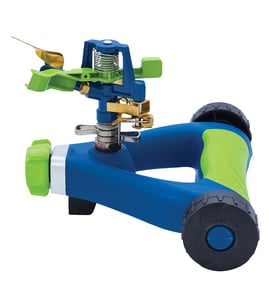

What is a Nelson Rain Train?
A NELSON Rain Train is a traveling lawn sprinkler that uses water pressure to drive itself along a garden hose path, watering as it moves. For the Craftsman Rain Train model NELSON, you lay out the hose route you want it to follow, then the sprinkler “walks” that path while spraying.
How it works (in plain terms)
Water flowing through the unit powers both the spray and the drive mechanism, so it can move without electricity.
- Connect it to a standard garden hose and turn on the spigot
- Set the hose in the route you want the sprinkler to travel
- The sprinkler follows the hose path while watering the surrounding area
- You can adjust coverage by changing water pressure and nozzle settings (if equipped)
- It keeps moving until it reaches the end of the hose route or water is shut off
What it’s used for
A traveling sprinkler is a good fit when you want to water a larger lawn area without moving a stationary sprinkler every 10 to 15 minutes.
| Sprinkler type | Best for | What you do during watering |
|---|---|---|
| Traveling sprinkler (Rain Train) | Long, open lawn sections | Set a hose path once, then let it run |
| Stationary sprinkler | Small or fixed zones | Move it to cover new areas |
Quick setup tips for better tracking
- Use a smooth hose path with wide turns (tight bends can cause stalls)
- Keep the hose flat on the grass (avoid loops and kinks)
- Start with moderate water pressure; too low can reduce drive power
- Clear sticks, edging, and steep bumps from the travel route
Why it matters
Because the Rain Train follows the hose you lay out, you control where it waters. That makes it easier to cover long strips of lawn, avoid sidewalks, and reduce dry spots compared with repeatedly repositioning a fixed sprinkler.
For replacement parts and model lookups, we recommend searching by your exact model details on Sears PartsDirect.
Last updated: February 2026
How to use a Nelson sprinkler?
To use a Craftsman NELSON Rain Train traveling sprinkler (model NELSON), we connect it to a garden hose, set the path and trip levers, then turn on the water and fine-tune speed and spray coverage. For model-specific replacement items, start with the parts list for this sprinkler or search by model at Sears PartsDirect.
Quick setup steps
- Lay out the hose path where you want the sprinkler to travel (avoid sharp kinks).
- Place the sprinkler at the start of the path on level ground.
- Connect a standard garden hose to the inlet fitting; hand-tighten, then snug slightly.
- Set the direction and distance controls (spray width/arc and range) before turning on water.
- Set the trip levers/stops so the sprinkler shuts off or reverses at the end of the run (depending on your version).
- Turn on the spigot slowly to reduce water hammer and help prevent leaks.
Dialing in coverage and travel speed
Most Rain Train style sprinklers move because water pressure drives an internal turbine/gear train. Small adjustments make a big difference.
| What you want | What to adjust | What to expect |
|---|---|---|
| More distance | Increase water flow, reduce spray resistance | Faster travel, longer throw |
| Slower travel | Reduce flow slightly, increase spray resistance | More soak time per area |
| Wider coverage | Open the spray/arc setting | More area, sometimes less distance |
| Straighter tracking | Smooth hose path, level the unit | Less wandering and stalling |
Common issues and fixes
- Sprinkler does not move: Check for low water pressure, clogged inlet screen/nozzle, or a kinked hose.
- Stops early: Reposition trip levers/stops; make sure the hose path is not pulling the sprinkler sideways.
- Leaks at the hose connection: Replace the hose washer, then re-tighten the coupling.
- Uneven spray pattern: Clean the nozzle and confirm the arc/deflector is set correctly.
Why it matters
Correct hose routing, trip-stop setup, and water-flow adjustment prevent stalling, reduce leaks, and help the Rain Train water evenly without over-soaking one spot.
Last updated: February 2026
How much water does a Nelson Tractor sprinkler put out?
Water output on a Craftsman Rain Train (model NELSON) depends mainly on your hose water pressure and the nozzle setting. Most traveling sprinklers of this type typically use about 3 to 6 gallons per minute (GPM), which equals 180 to 360 gallons per hour (GPH).
Quick ways to estimate your sprinkler’s water output
Use one of these methods to get a reliable number for your yard and water supply:
- Bucket test: Time how long it takes to fill a 5-gallon bucket from the sprinkler stream (or from the hose feeding it, using the same nozzle setting).
- Water meter method: Note your home water meter reading, run the sprinkler for 10 minutes, then calculate gallons used.
- Catch-can method: Place 6 to 10 identical cups along the travel path, run 15 minutes, then measure collected water to estimate application rate.
- Pressure check: If you have a hose-end pressure gauge, test static pressure at the spigot; higher pressure usually means higher GPM.
Conversions and examples
These conversions help you translate a measured flow rate into something useful for scheduling:
| If your sprinkler uses | That equals | What it means |
|---|---|---|
| 3 GPM | 180 GPH | Lighter watering, longer run time |
| 4 GPM | 240 GPH | Common mid-range output |
| 6 GPM | 360 GPH | Heavier watering, shorter run time |
Example: If you measure 5 gallons in 75 seconds, that is 4 GPM (5 ÷ 1.25 minutes).
Why it matters
Knowing GPM helps us match run time to your lawn’s needs. Too much flow can cause runoff on slopes or clay soil; too little flow can leave dry strips along the travel path. Once you know your GPM, you can adjust nozzle setting, travel speed, and hose length to get more even coverage.
Parts and model identification tip
If you are shopping for replacement parts for your Craftsman Rain Train, confirm the exact model identification first; traveling sprinklers often have similar names across years. Our guide on how to find your appliance model number (and what it means for parts) helps you locate and match the right model details, then you can search by model on Sears PartsDirect.
Last updated: February 2026
Why is my Nelson sprinkler not rotating?
If your Craftsman Rain Train (model NELSON) isn’t rotating, the most common cause is reduced drive force: low water pressure/flow, a clogged nozzle or turbine path, or a worn or damaged drive vane/gear that can’t “grab” the water stream to turn the sprinkler.
Quick checks that fix most no-rotation problems
- Confirm the hose bib is fully open and the hose isn’t kinked or crushed.
- Remove the nozzle (or front outlet) and rinse out sand, grit, or grass clippings.
- Check the sprinkler’s intake screen (if equipped) and clean it.
- Inspect the drive area for debris that can jam rotation (small stones, mulch, twigs).
- Verify the sprinkler is sitting level; a tilted body can bind the rotating head.
Focus area: drive vane and internal drive parts
On Rain Train style sprinklers, rotation depends on water striking a drive vane/turbine and transferring force into the gear train. If the drive vane is loose, chipped, or broken, the sprinkler may stop rotating or rotate inconsistently.
What to look for
| What you see | What it usually means | What to do |
|---|---|---|
| No rotation, but water sprays normally | Drive vane/turbine not engaging | Clean, then inspect for wear or breakage |
| Starts then stops | Debris intermittently jamming drive | Flush nozzle and drive path; remove debris |
| Slow rotation | Low pressure/flow or partial clog | Increase flow, shorten hose, clean nozzle |
| Rotates the wrong way or “hunts” | Damaged/loose drive vane | Re-seat or replace worn drive components |
Why it matters
Rotation is what spreads water evenly across your lawn. When the drive system slips or binds, you get dry spots, overwatered areas, and extra wear on the sprinkler’s gears and seals.
Getting the right replacement parts
For Craftsman NELSON Rain Train 1860/1861 parts, start with the parts list for this model; if you need to broaden your search by description or model details, use Sears PartsDirect.
Last updated: February 2026