

Why are radial arm saws no longer made?
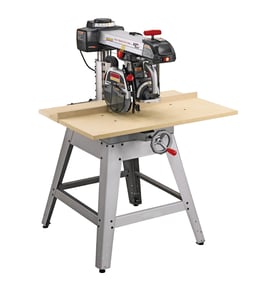
Radial arm saws (including older models like the Craftsman 11329520) largely faded from the market because most woodworkers shifted to tools that deliver similar crosscut capacity with simpler setup and more built-in guarding, especially sliding compound miter saws and table saws. That demand shift made new radial arm saw production less common.
What changed in the market
Radial arm saws can do a lot (crosscuts, miters, bevels, dados, and some ripping), but many shops replaced them with single-purpose tools that are faster to set up and easier to keep accurate.
- Sliding compound miter saws became the go-to for repeatable crosscuts and miters
- Table saws became the go-to for ripping and sheet goods
- Jobsite and benchtop tools improved, so fewer people needed one large, stationary saw
- Many users preferred lighter tools with easier alignment and calibration
- Retail shelf space and manufacturer focus moved to higher-volume saw categories
Safety and technique expectations
A radial arm saw is safe when it is set up correctly and used for the right cuts, but it demands more attention to feed direction, blade selection, and fence alignment than many modern alternatives.
- Ripping on a radial arm saw is more technique-sensitive than crosscutting
- Incorrect feed direction can increase the chance of climb or kickback
- Guarding and anti-kickback features vary widely by era and design
- Many users were not trained on best practices for ripping and dado work
Quick comparison: why many shops switched
| Task | Radial arm saw strength | Common modern replacement |
|---|---|---|
| Crosscutting long boards | Very good with a long table | Sliding compound miter saw |
| Ripping | Possible, but technique-sensitive | Table saw |
| Dados/half-laps | Very capable with the right setup | Table saw with dado set, router |
| Repetitive trim cuts | Good with stops | Miter saw station |
Why it matters for your Craftsman 11329520
Because new radial arm saws are less common, keeping a vintage saw running often comes down to maintenance and correct setup: a flat table, a straight fence, smooth carriage travel, and safe electrical condition (cord, switch, and connections).
For general DIY repair and maintenance habits that help with older tools, we recommend starting with are diy appliance repairs safe.
Last updated: February 2026
What are common problems with radial arm saws?
Common problems with the Craftsman 11329520 12" radial arm saw include inaccurate cuts from misalignment, rough or slow cutting from a dull blade, and electrical issues such as a bad switch or damaged cord. Most problems are solved by cleaning, tightening, aligning, and testing power components safely.
Most common symptoms and likely causes
- Inaccurate or out-of-square cuts: fence not straight, arm/yoke not locked, blade not square to table
- Blade wanders or burns wood: dull blade, wrong blade type for material, feed rate too fast
- Excessive vibration: blade not seated, arbor hardware loose, worn bearings, saw not bolted down
- Motor struggles or trips breaker: binding cut, extension cord too small, failing motor, bad capacitor (if equipped)
- Won’t start or cuts out: faulty switch, loose wiring, damaged power cord, worn brushes (if applicable)
- Poor depth control: worn elevation mechanism, sawdust packed in height/track components
Quick checks we recommend (safe, practical steps)
- Unplug the saw; verify the blade is tight and installed correctly.
- Confirm all locks are engaged (arm lock, yoke lock, bevel/miter locks) before cutting.
- Clean sawdust from the arm track, carriage rollers, and table area; buildup causes drift and rough travel.
- Check the fence for straightness and secure mounting; replace the sacrificial fence/table if it is chewed up.
- Inspect the cord and plug for cuts, heat damage, or loose prongs.
- If you suspect an electrical fault, test the switch and cord with a meter using how to use a multimeter to test electrical parts video.
Alignment basics (what “good” looks like)
| What you’re checking | What you want | What it affects |
|---|---|---|
| Blade square to fence | 90° crosscut | Cut accuracy, repeatability |
| Arm locked at 0° | No side play | Drift, out-of-square cuts |
| Carriage travel | Smooth, no binding | Chatter, burning, kickback risk |
| Table/fence condition | Flat and stable | Depth consistency |
Why it matters
Radial arm saws rely on rigid locks and accurate geometry. Small looseness in the arm, yoke, fence, or table multiplies into visible cut error and can increase binding and kickback risk.
Last updated: February 2026
Are radial arm saws worth anything?
Yes. A Craftsman radial arm saw like model 11329520 is worth something if it’s complete, runs smoothly, and can be tuned to cut accurately; value is driven more by condition and local demand than by age alone.
What typically affects value most
- Completeness: guard, table/fence boards, yoke and arm locks, and any original accessories
- Mechanical condition: smooth carriage travel, tight bearings, minimal arm play
- Motor health: starts quickly, no burning smell, no excessive sparking at brushes
- Accuracy: holds 90 degrees crosscut and returns to square consistently
- Rust and storage history: light surface rust is common; pitting and seized adjustments reduce value
- Footprint and stand: a solid base and intact table system can matter as much as the saw head
Typical price ranges you’ll see
Most used 10 to 12 inch radial arm saws sell locally in a wide range. For a Craftsman 12 inch class saw, these ranges are common:
| Condition | What it looks like | Typical local value |
|---|---|---|
| Parts/rough | missing guard, stiff slides, noisy motor | $0 to $75 |
| Usable | runs, complete, needs tune-up and table refresh | $75 to $200 |
| Clean and tuned | smooth travel, accurate cuts, minimal rust | $200 to $400 |
Quick checks before you buy or sell
- Unplug it; verify the arm lock and bevel/miter locks tighten firmly.
- Slide the carriage end-to-end; it should move smoothly without grinding.
- Spin the blade by hand (unplugged); listen for bearing roughness.
- Power it on briefly; watch for excessive vibration.
- Confirm the guard and anti-kickback hardware are present and functional.
Why it matters
Radial arm saws can be excellent for repeatable crosscuts and dados, but they take space and must be set up correctly. A saw that is complete and tunable is far more valuable than one that “runs” but cannot hold alignment.
Helpful related reading
Last updated: February 2026
When did Craftsman stop making radial arm saws?
Craftsman radial arm saws like model 11329520 were largely phased out of regular new-unit retail sales in the early-to-mid 1990s as compound miter saws became the primary choice for crosscuts and trim work. Most surviving units in use today are older, serviceable tools.
A practical timeline (what most owners see)
This is the most useful way to think about the changeover without tying every saw to one exact year:
- 1950s through early 1990s: Radial arm saws were common in Craftsman’s lineup
- Early-to-mid 1990s: New radial arm saw offerings became limited and then uncommon
- Late 1990s onward: Radial arm saws were rarely sold as mainstream new consumer tools
How to date a Craftsman 11329520 more accurately
The best way to narrow down when your specific saw was built is to use the identification information on the tool:
- Model tag on the base, column, or motor housing (confirm 11329520 exactly)
- Serial number (often the best clue for production range)
- Motor nameplate (may include date codes or revision info)
- Switch and guard style (design changes often track production updates)
| What you want to know | What to check on the saw | Why it matters |
|---|---|---|
| Approximate build era | Serial number and motor plate | Narrows the production window |
| Correct replacement parts | Full model number from the tag | Prevents ordering mismatched parts |
| Wiring and switch compatibility | Switch type and wire routing | Helps match electrical components safely |
For help locating the model tag and reading it correctly, use how to find your appliance model number (and what it means for parts).
Why it matters
Knowing the exact model number and build era helps you match mechanical parts (carriage and arm hardware) and electrical parts (switches and wiring) that can vary across production runs.
Last updated: February 2026